


Switzerland combines enormous purchasing power with a high affinity for e-commerce – a tempting market for European online retailers. However, the customs border between the EU and Switzerland poses operational challenges for many. While cross-border shipping makes it easier to get started, local fulfillment can be the more profitable solution above certain thresholds. The decisive factor here is not just shipping costs, but the total cost of ownership.
The Swiss market: high-priced, affluent, demanding
With a purchasing power of around 80,000 euros GDP per capita and an online retail volume of 15.8 billion Swiss francs per year, Switzerland is one of the most lucrative e-commerce markets in Europe. Particularly noteworthy: 18 percent of this is accounted for by orders placed abroad.
The reason for this is the structurally high price level: identical products often cost much more in Switzerland than in Germany. This price arbitrage drives Swiss consumers to foreign stores. But if you want to serve this market successfully, you have to meet high expectations: Transparent prices in Swiss francs, no hidden customs duties, local payment methods such as TWINT, fast delivery times and smooth returns processes are a must, not a nice-to-have.
Added to this is the regulatory complexity: every shipment to Switzerland crosses a hard customs border. The abolition of industrial tariffs in 2024 and the introduction of platform taxation in 2025 have brought administrative relief, but customs declarations and import taxes remain mandatory.
European retailers who want to expand into the Swiss market can basically choose from three logistics models, each with their own strengths and weaknesses. These are examined in more detail below.
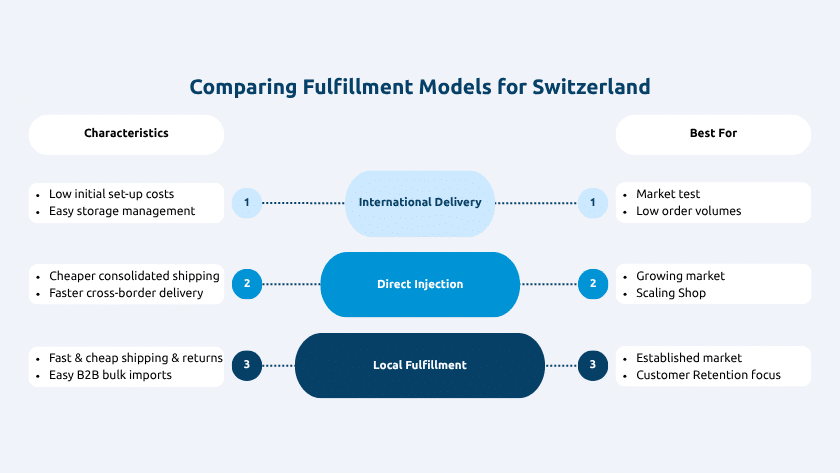
Cross-border shipping: The classic entry with limits
Classic cross-border shipping from the existing EU warehouse with an international shipping service provider is a frequently chosen method.
Especially smaller stores or retailers who want to test the market benefit from the flexibility, minimal setup costs and simple warehouse management that this model offers.
On the other hand, these advantages come at the direct expense of the customer experience. Longer delivery times of three to seven days at a shipping price two to three times higher than for domestic shipments are standard. In addition, each parcel must be individually declared to customs, which only justifies the complexity and administrative effort for small volumes.
Particularly critical: returns management is becoming a loyalty killer. Swiss customers who return parcels have to fill out customs documents, pay high postage costs and accept long refund times.
Direct injection: The intelligent intermediate solution
With direct injection, orders continue to be picked in the EU central warehouse, but are already provided with final shipping labels from local Swiss delivery services there. The parcels are then transported across the border as consolidated bulk freight and only injected directly into the local carrier’s distribution center after collective customs clearance.
Experience has shown that consolidation over long distances reduces shipping costs by up to 30 percent and improves delivery speed by one to two days compared to traditional cross-border shipping. Swiss customers receive their parcel from their trusted local delivery service, which creates trust and increases the likelihood of delivery on the first attempt.
However, direct injection only pays off for several hundred orders per month to Switzerland, as this model incurs fixed costs for bundled transportation, consolidation and IT integration with local carriers.
Regardless of the shipping model chosen, the Incoterm DDP (Delivery Duty Paid) is a critical factor for Swiss customers these days. This means that the retailer proactively pays all customs and tax duties in advance. Surveys show that over 80 percent of Swiss consumers surveyed refrain from buying from a foreign retailer if no pre-customs clearance is offered.
Setting up your own logistics takes time, knowledge, infrastructure and personnel. Long-term planning is the key to success. The infrastructure should be expandable, the staff available and the processes scalable. Non-optimized logistics can lead to an increased error rate, which in turn affects the store’s reputation.
Local fulfillment: maximum performance, maximum effort
With local fulfillment, a dedicated part of the inventory is physically relocated to Switzerland and usually managed by a local fulfillment service provider. Orders are picked directly on site and sent as national domestic shipments.
The advantages are particularly evident in the quality of service: delivery times are reduced to one to two working days – exactly the level that Swiss consumers expect. Shipping costs are reduced to favorable national prime rates. Complex customs declarations are no longer necessary, as goods are imported and cleared efficiently in large quantities as B2B bulk. Returns can be processed quickly and cost-effectively as customers send back to a domestic address.
Those who work with a local service provider such as MS Direct also save time during the initial set-up due to existing warehouse infrastructures and overhead costs, as VAT registration and fiscal representation are also covered. Retailers also benefit from discounted shipping prices below the basic rate for ongoing business.
The biggest challenge in local fulfillment lies in inventory allocation. Retailers need precise demand forecasts in order to avoid bottlenecks or excess stock in local warehouses.

The strategic tipping point: when local fulfillment pays off
Unlike in the EU single market, the decision to opt for local fulfillment in Switzerland is not primarily driven by transport costs, but by a holistic total cost of ownership (TCO) approach. There are around ten fundamental mechanisms that make the business case for an external warehouse attractive:
- Conversion rate increase: Guaranteed delivery within one to two working days from within Germany eliminates the biggest checkout barrier. The absolute certainty that no customs charges will be incurred at the front door lowers the purchase abandonment rate and massively increases conversion.
- Mandatory fiscal triggers: Companies with an annual turnover of CHF 100,000 or more are subject to VAT in Switzerland. From this point onwards, retailers must appoint a fiscal representative, regardless of whether they ship from abroad or locally. As soon as these fixed administrative costs are incurred, the marginal cost hurdle for a local warehouse drops drastically.
- Customer retention: The reliable customer experience provided by domestic shipping transforms one-time buyers into loyal existing customers. The optimized experience is also reflected in an improved Net Promoter Score (NPS).
- Customer acquisition costs: The higher repurchase rate reduces customer acquisition costs (CAC) in the long term, as marketing expenditure is spread over higher sales. This in turn frees up budgets for further growth measures.
- Service cost reduction: Cross-border shipping generates high support volumes due to inquiries about customs delays and unexpected fees. Local fulfillment completely eliminates these contact reasons and significantly reduces the burden on customer service.
- Optimized import logistics: Instead of clearing hundreds of small B2C parcels individually every day, local fulfilment enables the bundled import of B2B goods. Freight costs per item are reduced to a minimum and customs clearance is highly efficient in large batches.
- Returns management as a margin driver: In sectors with high returns rates – fashion reaches up to 60 percent in Switzerland according to Swiss Post – local fulfillment pays for itself the fastest. Returns remain in the country, are checked immediately and can be sent directly to the next Swiss customer.
- Fewer cases of damage: Every additional touchpoint in logistics increases the risk of damage. Direct domestic shipping to the end customer reduces handling processes to a minimum, which significantly lowers damage rates.
- Less administrative overhead: Managing cross-border shipments requires daily attention to customs declarations and potential data errors. Local fulfillment significantly reduces these efforts as goods are transported across the border less frequently and in bulk.
- Competitive advantage through Amazon vacancy: Unlike in Germany or the UK, Amazon’s Prime network is barely present in Switzerland due to regulations. Retailers with local fulfillment can independently offer delivery speeds that even Amazon cannot achieve in this market – an almost unassailable competitive advantage.
- These positive factors are further enhanced when working with a local fulfillment service provider. On the one hand, expensive investments in warehousing and personnel are eliminated and, on the other, the cost structure changes from fixed to variable costs. Fiscal representation is also taken over by most providers. And last but not least, retailers also benefit from long-term security, as they can scale up without major investments.
Growing together in Switzerland
There are many ways to expand into the lucrative e-commerce market in Switzerland – be it with cross-border shipping or local fulfillment. When choosing the right process, it is important to consider the TCO. Especially in industries with high return rates and a focus on customer lifetime value, the advantages of local fulfillment clearly outweigh the disadvantages.
MS Direct advises you on entering the Swiss market and supports you in finding the right model for your situation. As a local e-commerce logistics service provider with many years of experience, we offer smart solutions for local fulfillment, cross-border shipping and returns.
A look at the practice

Peter Egger, VP Grwoth at MS Direct
Peter Egger has over 18 years of experience in the fulfillment and cross-border business and has accompanied numerous online stores in their international expansion into Switzerland during his career. He provides insights into successful expansion strategies.
Peter, how do you proceed when an online retailer wants to expand into Switzerland?
We always look for the best individual solution. The initial situation is crucial: has the retailer already established decentralized logistics structures in other countries or has it only worked with central fulfillment up to now? Then we take a close look at the operational requirements: How important are short delivery times and late cut-off times for the business model? What shipping volumes does the store currently achieve in Switzerland? How many different SKUs does the range include, and what are the product dimensions of the items? All these factors are included in our recommendation.
In your experience, for which stores is local fulfillment particularly lucrative?
Retailers with lean product ranges and compact products – i.e. fewer SKUs with smaller dimensions – benefit the most. Low seasonality is also advantageous because frequent collection changes complicate inventory planning. And with larger order volumes, the costs are naturally amortized more quickly.
Switzerland Fulfillment is also interesting for retailers who handle direct imports from China: These goods can be imported into Switzerland duty-free, which creates a massive cost advantage. If a retailer is also pursuing a marketplace strategy and must adhere to strict SLAs, local fulfillment is often the best way to reliably meet the requirements.
Last but not least, local fulfillment also offers advantages in highly competitive markets. If delivery speed and returns service are decisive differentiators, you are naturally better positioned with local deliveries.
Is there a common denominator among your customers who benefit from local fulfillment?
Yes, we work with a wide range of brands from various industries that have scaled their Swiss expansion via our local fulfillment. The spectrum ranges from fashion and beauty to consumer electronics and pet supplies. What they all have in common: They have recognized the Swiss market as strategically important and have taken their customer experience to a new level through local presence.
What makes MS Direct fulfillment special?
MS Direct has over 50 years of experience in the logistics business. Over the years, we have built up reliable processes that allow stores of different sizes to expand and scale in Switzerland without any worries. Through AI-supported forecasting systems and the use of robotics, we ensure cost-efficient order processing and operational stability – even at peak times. This enables our customers to easily sell on Swiss marketplaces if they so wish.
Transparency is particularly important to us: our customers have a complete overview of stocks, orders, shipments and SLA compliance at all times via real-time interfaces. Each customer is assigned a personal Customer Success Manager who accompanies and supports them in their growth.
Fulfillment calculator.
Use our online calculator to work out how much a fulfillment service will cost you.
- Detailed information about your product range and shipping requirements
- 100% non-binding and free price calculation based on your details
- Get an instant price estimate for your customized set-up
